Dolly Parton’s Knoxville: The East Tennessee Places That Help Tell Her Story |
From early radio appearances to UT, Dollywood and children’s literacy, Knoxville is woven throughout Dolly Parton’s East Tennessee story. |
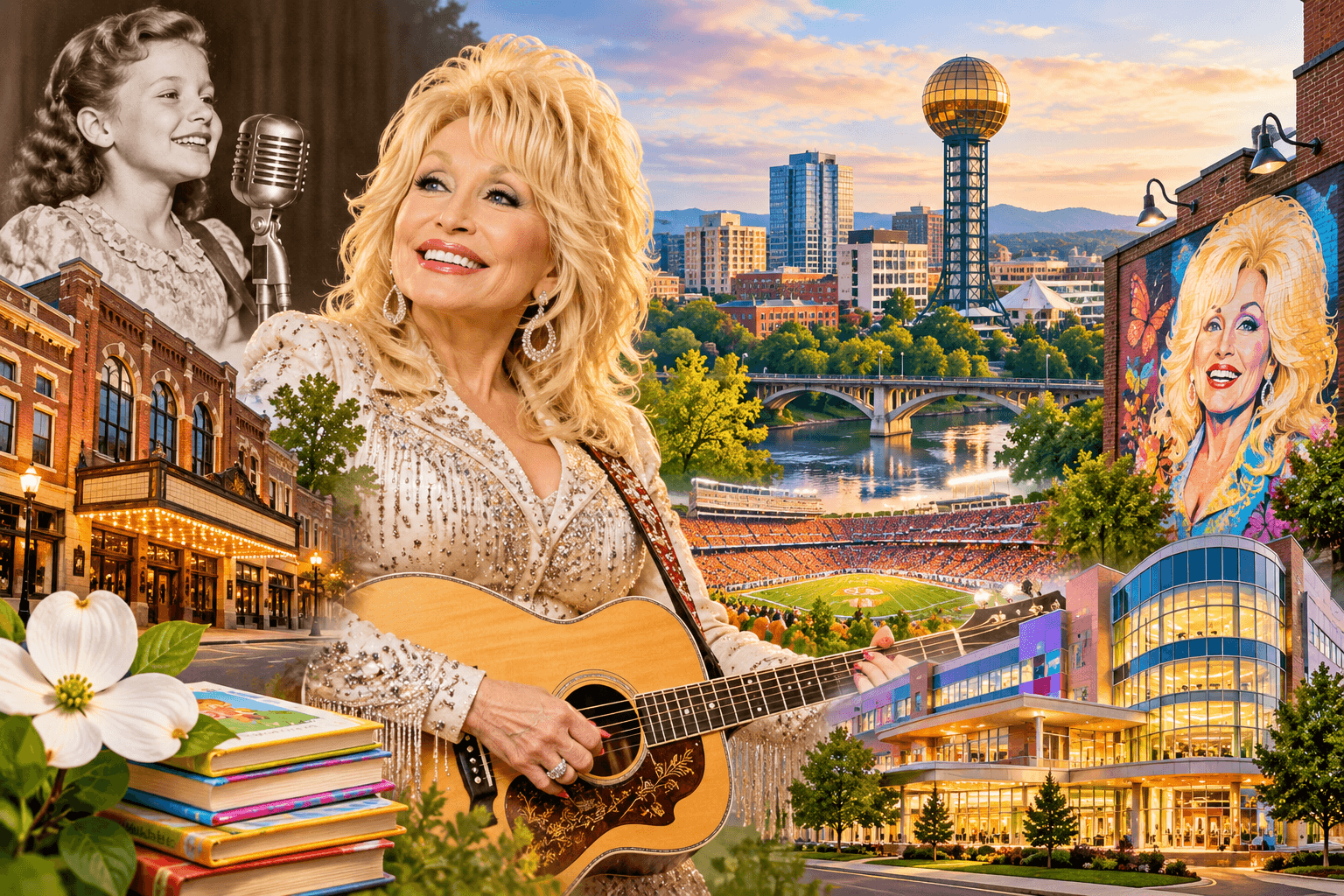
For someone so closely associated with the mountains of Sevier County, Dolly Parton also left a surprisingly deep footprint in Knoxville.
She was not a Knoxville native, and this is not where most people begin when telling her story. But long before Dollywood, international tours and decades of superstardom, Knoxville gave a young Dolly some of her first real audiences. Later, the city’s universities, hospitals, theaters and public spaces became part of the legacy she built across East Tennessee.
That connection feels especially significant now. Parton died Aug. 25 at age 80, prompting tributes across Tennessee and beyond. In Knoxville, the response has been particularly personal because so many pieces of her story can still be traced to actual places residents pass every day.
North Gay Street: Where Knoxville First Heard DollyOne of the most important Dolly landmarks in Knoxville is surprisingly easy to miss.
At 319 N. Gay Street, a brick building once housed the studios of WIVK. Beginning when she was about 10 years old, Parton traveled from Sevier County to Knoxville with her uncle, musician Bill Owens, to perform on local radio. She became a regular presence on WIVK and also appeared on Cas Walker’s broadcasts during the years when live radio and television could still give young regional performers their first serious exposure.
The importance of that period is easy to underestimate today.
In the 1950s, Knoxville was one of East Tennessee’s major broadcasting centers. For a child growing up in the mountains outside Sevierville, appearing on Knoxville radio meant reaching an audience far beyond family gatherings, school functions or local performances.
Parton later recalled that performing for those early audiences helped confirm what she already believed about herself: she wanted to sing for people.
Today, the old WIVK building remains on North Gay Street, and a historical marker nearby commemorates her early broadcasting career. The location sits only a short walk from the Old City and the heart of downtown Knoxville.
Cas Walker and the Knoxville Television Years
Another major Knoxville connection came through businessman and broadcaster Cas Walker.
Walker became famous locally for his grocery stores, outspoken personality and long-running radio and television programs. His Farm and Home Hour gave regional musicians a platform, and Parton became one of the young performers who appeared regularly.
Knoxville historian Jack Neely has estimated that Parton may have performed on Knoxville radio and television hundreds of times during those early years, even though relatively little newspaper coverage of the young singer survives.
Those appearances mattered because they helped bridge the distance between her Sevier County childhood and the Nashville career she would pursue after graduating from high school in 1964.
Knoxville was not the final destination. It was the proving ground.
The Bijou Theatre: An Early Connection That Came Full Circle
The historic Bijou Theatre adds another chapter.
Parton had spoken over the years about appearing at the Bijou when she was young, although details about those earliest performances are less firmly documented.
What is confirmed is that she returned to the Bijou in a major way in May 2024, when she and members of her family gathered there for three days of recorded performances connected with Dolly Parton & Family: Smoky Mountain DNA – Family, Faith & Fables.
The project explored both sides of her family — the Partons and the Owenses — and their musical traditions.
That made the Bijou an especially fitting setting. A century-old Knoxville theater that once hosted touring entertainers became a place where Parton returned late in her career to document the very family and mountain traditions that helped shape her music.
The University of Tennessee: From Commencement Stage to Neyland Stadium
Parton never attended the University of Tennessee, but she developed one of her strongest institutional connections in Knoxville there.
In 2009, UT Knoxville invited her to deliver the College of Arts and Sciences commencement address. During the ceremony, the university awarded her an honorary doctorate of humane and musical letters — only the second honorary degree UT Knoxville had granted at the time.
Parton performed during the ceremony as well, including “Rocky Top.”
Her relationship with UT continued. She later performed at the university’s arena, and in November 2023 she returned for one of her most memorable Knoxville appearances: singing “Rocky Top” at Neyland Stadium during the Tennessee-Georgia football game.
After her death, Tennessee football announced that players would wear a commemorative Dolly Parton helmet sticker throughout the 2026 season. The Pride of the Southland Band also honored her during the season opener by forming the word “Dolly” and her signature butterfly on the field.
For a woman who spent much of her career carrying East Tennessee culture to audiences around the world, Neyland Stadium became one of the largest places where East Tennessee could return the affection.
Dolly Parton Children’s Hospital: Her Name on Knoxville Healthcare
Perhaps the most substantial new Knoxville connection came in February 2026, when East Tennessee Children’s Hospital announced that it was becoming Dolly Parton Children’s Hospital.
The partnership tied Parton’s name to one of Knoxville’s most important regional institutions for children and families. At the announcement, Parton connected the project directly to the values she associated with growing up in East Tennessee — community, care and looking after children.
The hospital’s reach extends well beyond Knoxville, serving families across East Tennessee and neighboring areas.
The connection is also growing academically. In September, the hospital and the University of Tennessee Health Science Center College of Medicine-Knoxville announced a new pediatric residency program scheduled to begin in July 2027. The program is expected to train eight physicians initially and eventually grow to 24 pediatric residents.
That makes the Dolly Parton name in Knoxville more than a memorial or honorary gesture. It is now attached to an institution providing pediatric care and helping train future doctors.
The Imagination Library: A Sevier County Idea With Knoxville Reach
One of Parton’s most consequential East Tennessee projects started just down the road from Knoxville.
In 1995, she launched Dolly Parton’s Imagination Library for preschool children in Sevier County. The idea was simple: send a free book every month to participating children from birth to age five, regardless of family income.
That local program eventually expanded across Tennessee, then nationally and internationally. The organization now mails millions of books each month.
Knoxville has become part of that story in several ways.
Local families can participate through area Imagination Library partners, and the University of Tennessee’s Land Grant Films produced the documentary The Library That Dolly Built, chronicling the development of the program. The film was directed and produced by UT journalism professor Nick Geidner.
Just this month, UT held a free public screening of the documentary in Knoxville, with representatives from the Knox County Imagination Library available to help families enroll children and support the program.
That is an unusually direct line from Parton’s childhood in Sevier County to families receiving books in Knoxville today.
Strong Alley: Dolly as Public Art
Not every Knoxville connection is institutional.
One of the most visible is painted on a downtown wall.
A large Dolly Parton mural in Strong Alley, between Gay Street and Market Square, first appeared in 2019. San Antonio muralist Colton Valentine created the original portrait. After it was vandalized in 2020, East Tennessee artist Megan Lingerfelt restored it with support from Dogwood Arts.
It has since become one of the most recognizable pieces of public art downtown.
That mural says something about the way Knoxville relates to Parton. She is remembered not only through formal honors but through murals, festivals, music, costumes and public celebrations.
For years, Knoxville’s Old City has also hosted Rhinestone Fest, a community celebration inspired by Parton that brings together music, art, vendors and plenty of rhinestones.
Sevierville: The Beginning Is Still Just Down the Road
Any Knoxville-centered look at Dolly Parton ultimately points back toward Sevier County.
In downtown Sevierville, the bronze Dolly Parton statue outside the Sevier County Courthouse has stood since 1987. Local artist Jim Gray sculpted the barefoot, guitar-playing figure, which Parton herself helped unveil.
Nearby, The Pines marks another important early chapter. The historic theater hosted Parton’s first paying performance when she was about 10 years old. The building now operates as The Pines Downtown.
The original Imagination Library also began in Sevier County, and the Dollywood Foundation remains headquartered in downtown Sevierville.
A few miles away in Pigeon Forge, Dollywood became the largest physical expression of Parton’s decision to invest heavily in the region where she grew up.
She joined the Herschend family in 1986 to transform Silver Dollar City Tennessee into Dollywood. Over the following decades, the park and its related businesses became major employers and tourism anchors for the Smokies.
A Local Story Hidden in Familiar Places
That is what makes Dolly Parton’s Knoxville connection interesting.
There is no single “Dolly site” that tells the whole story.
Instead, her East Tennessee life is spread across a surprisingly compact geography: a brick building on North Gay Street where a child first sang on Knoxville radio; a century-old theater where she returned decades later with her family; a university that awarded her an honorary doctorate; Neyland Stadium, where more than 100,000 people once joined her in “Rocky Top”; a children’s hospital now carrying her name; and a literacy program that began in neighboring Sevier County and still puts books into the hands of local children.
Even Knoxville itself marked her passing. City records show decorative downtown lighting was changed for several days after her death in remembrance of her legacy.
For residents, those connections make Parton’s story feel less like distant celebrity history and more like East Tennessee history.
Long before the world knew Dolly Parton, people in Knoxville could turn on the radio and hear a girl from the mountains singing.
And decades after those first appearances, the places that helped launch her still carry pieces of her story. |
0 Comments
Join the conversation
Be the first to comment
Share your thoughts above.