Market Square Then and Now |
From farmers’ wagons and a towering Victorian market house to restaurants, concerts, and festivals, Knoxville’s best-known public square has been reinventing itself for more than 170 years. |
Long before Market Square became a destination for outdoor dining, live music, and weekend crowds, it was created for a much simpler purpose: giving local farmers a central place to sell what they grew.
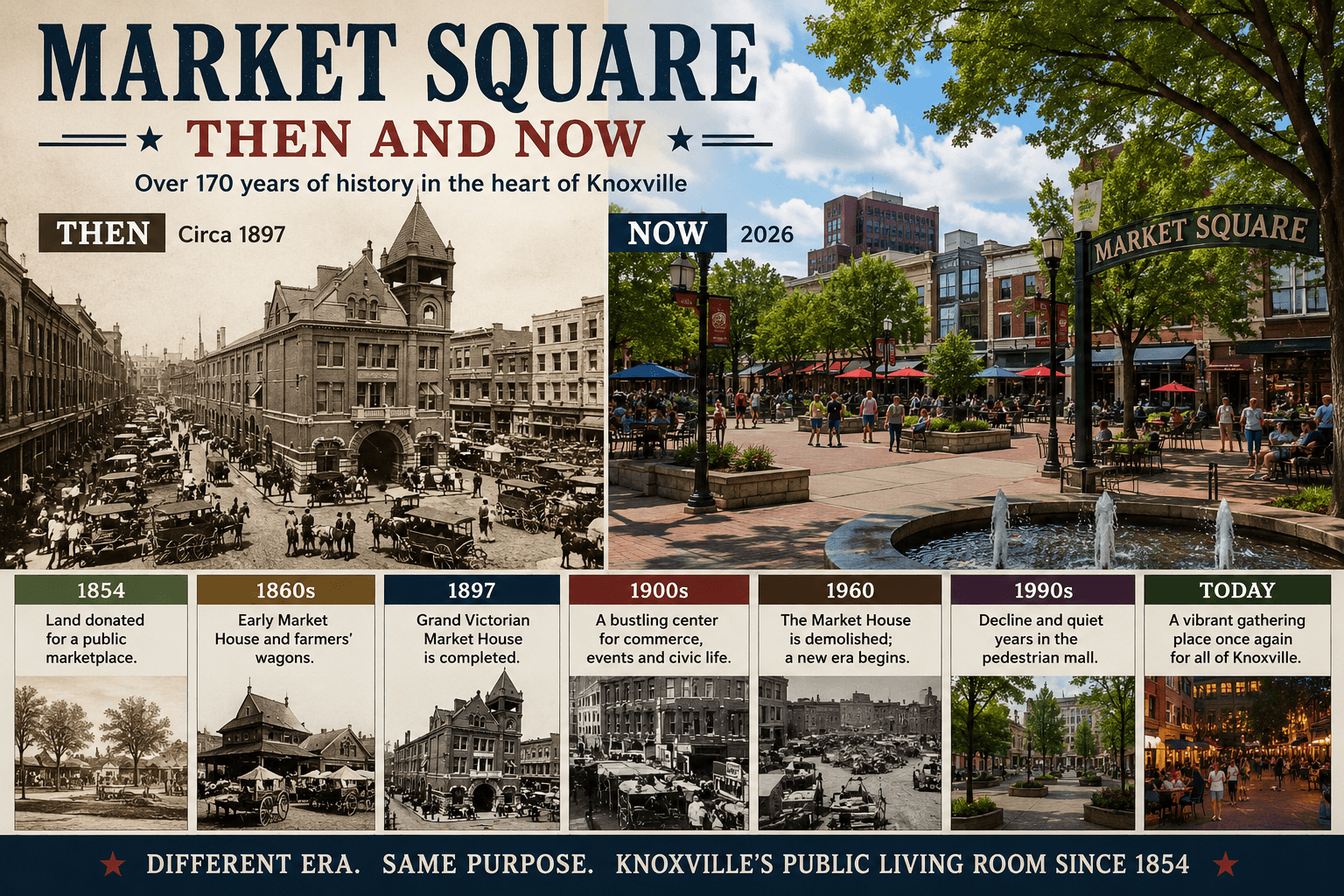
Developers William Swan and Joseph Mabry donated the land to Knoxville in 1854, and the city constructed a small brick market house near what is now the grassy southern end of the square. Farmers arrived by wagon with produce and other goods, while businesses gradually opened along both sides. By 1870, rows of buildings had formed the recognizable shape of Market Square that visitors still see today.
The square quickly became much more than a produce market. Over the years, its buildings housed grocery stores, saloons, boarding houses, newspaper offices, restaurants, bakeries, apartments, barbers, jewelers, small theaters, and even one of Knoxville’s earliest bowling alleys. Immigrants and Black business owners were part of the commercial life that made the square one of the city’s most diverse gathering places.
Knoxville’s first permanent City Hall opened at the northern end of the square in 1868. It included city offices, a police station, a jail, and a bell tower that could alert residents to fires and other emergencies. During the Civil War, Union forces used the original Market House as a barracks and ammunition magazine.
The most dramatic version of the square arrived in 1897, when Knoxville replaced the earlier structure with a massive Victorian Market House. The tall brick building contained space for approximately 60 vendors on its ground floor, along with offices, public facilities, and an auditorium upstairs. Rather than today’s broad open plaza, visitors moved through two busy lanes running along either side of the building.
The square also became a stage for civic life. Suffragists organized there, Booker T. Washington delivered a speech there in 1909, and generations of politicians, activists, musicians, veterans, vendors, and street performers used the space to be heard. It earned a reputation as a place where people from very different backgrounds regularly crossed paths.
By the middle of the 20th century, however, downtown Knoxville was changing. The Market House was demolished in 1960 after years of debate, and the square was remade as a modern pedestrian mall. As shopping shifted toward suburban commercial centers, Market Square experienced long stretches of decline. Farmers continued to appear, but by the 1990s only one was reportedly selling there regularly.
Its modern revival began around the turn of the century. Historic protections, public improvements, private investment, restaurants, apartments, and the return of a producer-focused farmers market helped bring people back. The square once again became a place to shop, eat, gather, perform, protest, celebrate, and simply watch Knoxville go by.
Today’s Market Square looks very different from the wagon-filled marketplace and imposing Market House captured in old photographs. Yet its basic purpose has survived every reinvention. It remains Knoxville’s public living room, a place where commerce, culture, history, and everyday life meet in the same few blocks. |
0 Comments
Join the conversation
Be the first to comment
Share your thoughts above.