Gay Street’s Reinvention: How Downtown Knoxville Came Back |
From vacant storefronts to historic theaters and renewed street life, Knoxville's signature corridor found a second act |
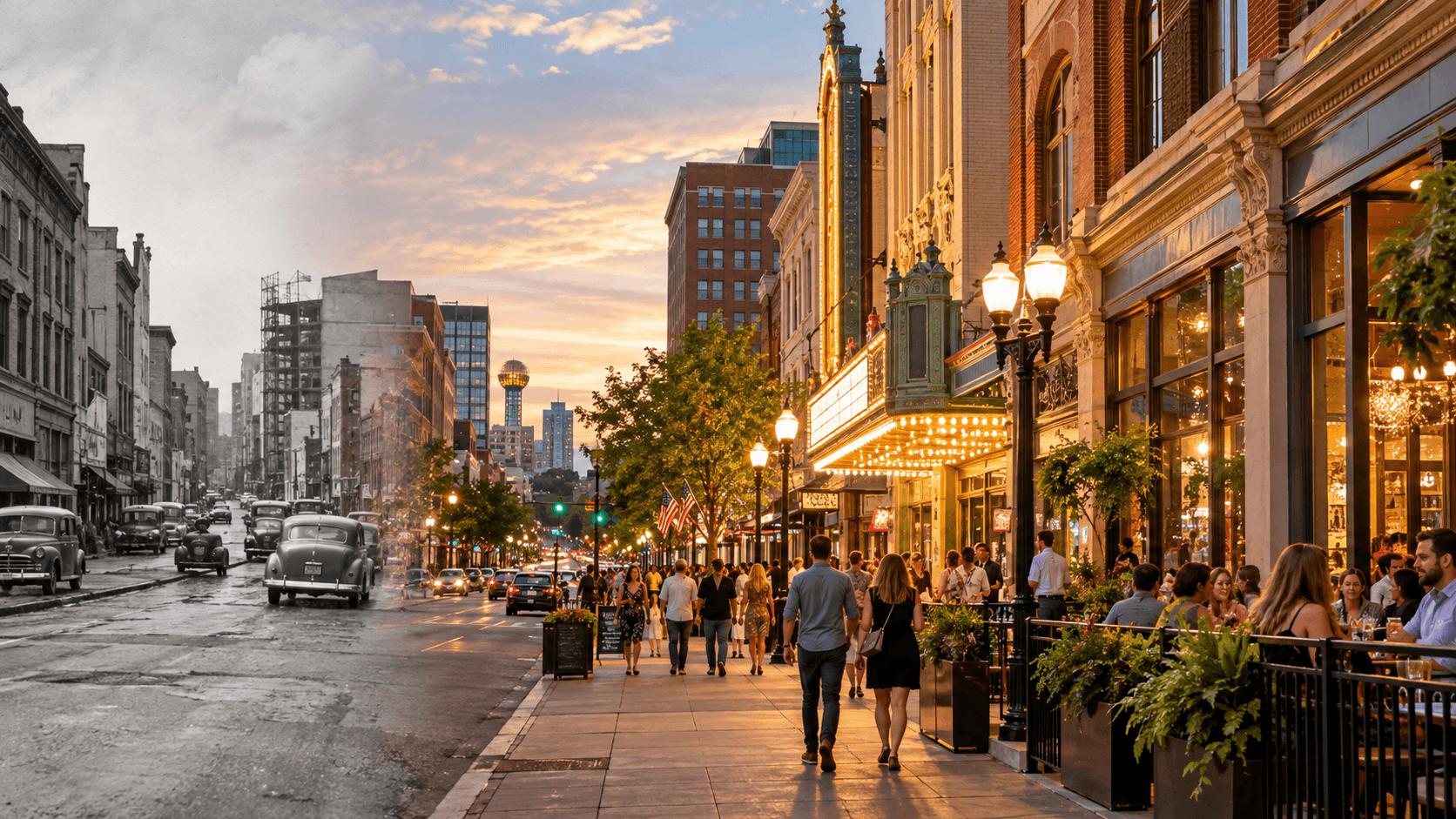
Walk along Gay Street today and it is easy to believe downtown Knoxville has always looked this lively.
Historic theaters glow after dark, people linger outside restaurants, residents come and go from converted buildings, and visitors stop to admire architecture that has survived several generations of change.
But this stretch of downtown once faced a far less promising future.
The story of Gay Street’s reinvention is not simply about new businesses moving into old storefronts.
It is a story about what Knoxville chose to save, what it almost lost, and how a city gradually rediscovered its main street.
A Street That Helped Build Knoxville
Gay Street has played a central role in Knoxville life since the city's earliest decades in the 1790s.
Before modern shopping centers and sprawling suburbs, its storefronts, hotels, offices and theaters made it a natural gathering place for commerce and public life.
By the late nineteenth and early twentieth centuries, the street had become a center for wholesalers, merchants and department stores.
Sterchi Brothers Furniture Company grew into a major regional business, and its distinctive building remains one of downtown's recognizable landmarks.
Miller's Department Store helped make Gay Street a shopping destination, while generations of Knoxville residents knew the street as a place for parades, celebrations and everyday errands.
The architecture still reveals that prosperous period.
Brick commercial buildings, elaborate facades and former business headquarters reflect an era when downtown streets were the center of a city's economic and social life.
When the Crowds Moved Elsewhere
After World War II, changing transportation habits and suburban growth reshaped shopping across the country.
Knoxville was no exception.
By the 1970s, suburban malls and commercial districts were drawing customers and investment away from the historic downtown core.
Long-established businesses moved, closed or struggled, leaving vacant storefronts and aging buildings behind.
Some structures deteriorated, and demolition appeared more practical to some observers than rehabilitation.
The question was no longer whether Gay Street would change, but whether enough of its character would survive.
The threat was especially visible in the struggle to preserve the Bijou Theatre, which closed in 1975 and faced possible demolition.
Preservation advocates rallied around the building, demonstrating that historic architecture could still have a meaningful role in Knoxville's future.
Saving Buildings, Recovering Identity
The comeback did not arrive with one ribbon-cutting or a single grand project.
It unfolded through years of preservation campaigns, public planning, private investment and a changing understanding of downtown's potential.
Historic recognition helped establish why the street mattered.
The Southern Terminal and Warehouse Historic District was added to the National Register of Historic Places in 1985, followed by the Gay Street Commercial Historic District in 1986.
Knoxville then adopted downtown improvement plans in 1987 and 1988, with attention to sidewalks, landscaping, street furnishings and the pedestrian experience.
Those improvements were important, but they were only part of the solution.
Old buildings needed people and viable uses, not just fresh pavement.
Redevelopment incentives introduced in the early 2000s helped encourage owners and investors to convert underused properties into housing, offices, restaurants and shops.
The goal was to make downtown a neighborhood as well as a destination.
Theaters Helped Turn the Lights Back On
Two historic theaters became powerful symbols of that transformation.
The Tennessee Theatre, opened in 1928, underwent a major restoration and reopened in 2005.
Its restored marquee and elaborate interior offered a visible reminder that the grandeur of an earlier Knoxville could still draw modern audiences.
The Bijou's path was more complicated, including another closure in 2004 before a preservation and operating plan helped bring performances back in 2006.
Together, these venues reinforced Gay Street's identity as a cultural destination.
A night downtown could once again mean dinner, a concert, a stage performance or an unhurried walk beneath familiar signs.
The Curious Street Beneath the Street
One of Gay Street's most surprising features is not immediately visible to people walking above it.
In 1919, the 100 block was raised more than a story above its original level, creating a bridge-like support structure beneath the roadway.
Decades later, that unusual construction required serious attention.
A major 2009 streetscape project reconstructed portions of the 100 and 200 blocks, upgraded utilities, replaced pavement and sidewalks, and repaired the infrastructure supporting the elevated section.
These were not especially glamorous improvements, and construction disrupted the businesses that had already taken a chance on downtown.
But the work demonstrated an important reality of urban revival: preserving a historic street also means investing in the infrastructure people cannot see.
A Main Street Becomes a Neighborhood Again
As restored buildings gained new purposes, Gay Street became more than an office corridor or entertainment strip.
Former commercial spaces found new life as apartments and other residential properties, bringing people downtown beyond the traditional workday.
Restaurants, galleries, shops and cultural events gave those residents and visitors more reasons to stay.
Nearby Market Square and the Old City contributed to a broader downtown revival, creating a walkable collection of destinations rather than one isolated block of activity.
First Friday arts events, holiday parades and other gatherings helped return a shared civic rhythm to the street.
In 2012, the American Planning Association recognized Gay Street as one of America's Great Streets, acknowledging its preservation, design and renewed community life.
That designation was a milestone, not the end of the story.
What Gay Street's Comeback Really Means
Revitalization brings questions along with opportunity.
Rising interest in downtown can put pressure on independent businesses, housing affordability and the balance between preserving familiar places and welcoming new ones.
Successful preservation also requires continuing maintenance, accessible public space and room for different kinds of people to participate in downtown life.
Gay Street's future will depend on how Knoxville manages those pressures, not merely on how busy the sidewalks appear on a Saturday night.
Still, the contrast with its struggling decades is remarkable.
Instead of treating its older buildings as obstacles, Knoxville increasingly recognized them as assets that could make downtown distinctive.
Instead of asking people to visit only for a quick errand, the street now invites them to eat, live, explore and linger.
The reinvention was never about making Gay Street look brand-new.
It was about giving a historic street enough new purpose to remain part of Knoxville's everyday life.
The next time you walk past the Tennessee Theatre, look up at the Sterchi building or cross the 100 block, consider the layers of city history beneath your feet.
Gay Street did not simply survive Knoxville's changes.
It became one of the places where the city learned how to move forward without leaving its past behind. |
0 Comments
Join the conversation
Be the first to comment
Share your thoughts above.