Norris Dam and the Birth of TVA |
Discover the untold history behind Norris Dam and the groundbreaking creation of TVA. |
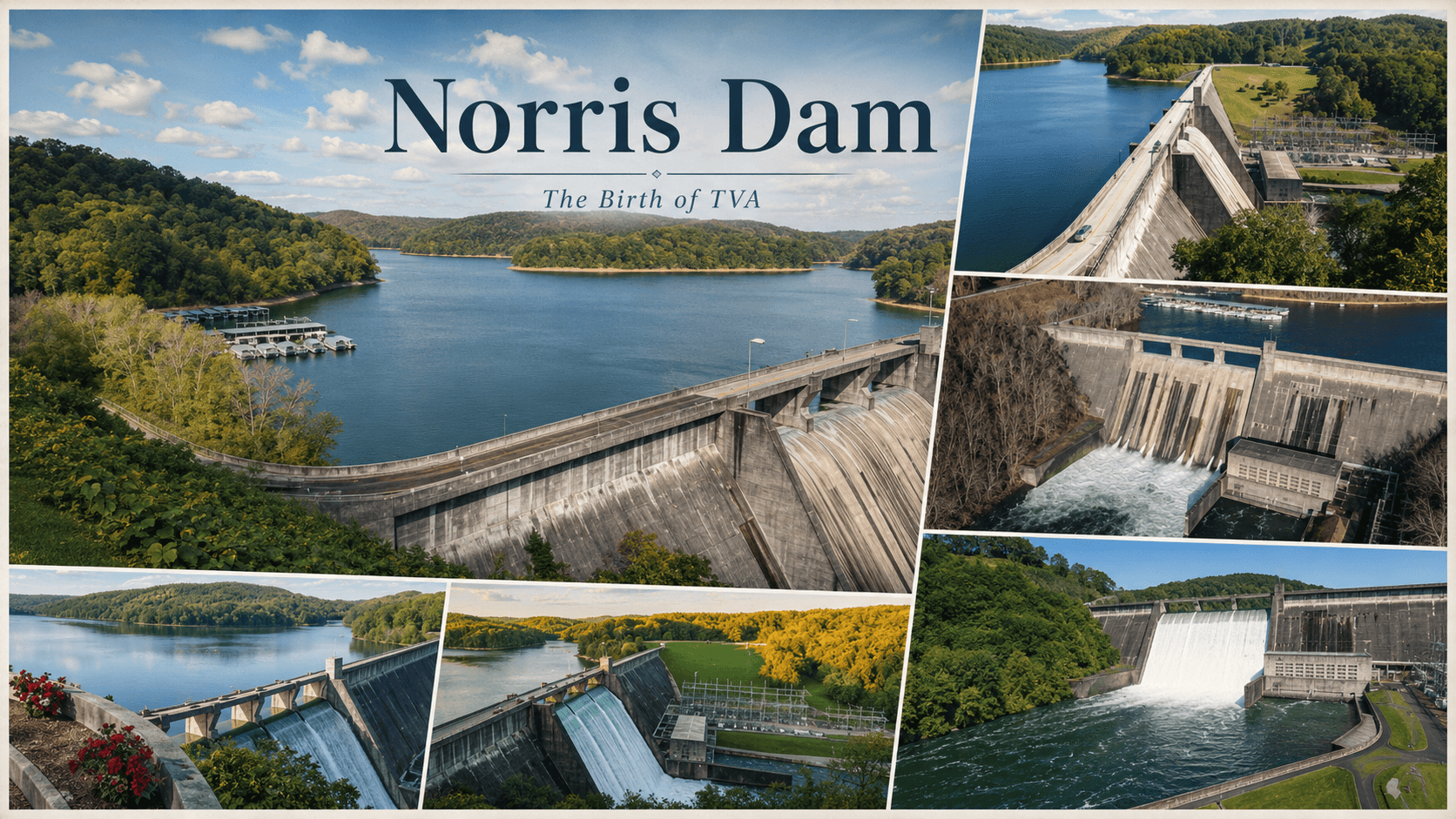
Today, Norris Dam feels like a peaceful East Tennessee escape.
Visitors come for lake views, fishing, boating, hiking, camping, and quiet drives through the hills north of Knoxville. Norris Lake stretches across the region with hundreds of miles of shoreline, while Norris Dam State Park offers cabins, trails, overlooks, and reminders of an earlier era of American public works.
But behind the calm water is one of East Tennessee’s biggest transformation stories.
Norris Dam was the first major hydroelectric project built by the Tennessee Valley Authority, the federal agency created in 1933 as part of President Franklin D. Roosevelt’s New Deal. At the time, the Tennessee Valley was a region of recurring floods, limited electricity access, worn-out farmland, and deep economic hardship. TVA was designed to address several problems at once: flood control, navigation, electricity, land management, economic development, and regional modernization.
Norris Dam became the proof of concept.
Construction began in 1933 on the Clinch River, only a few months after TVA was created. By 1936, the dam was complete. At 265 feet high and 1,860 feet long, the concrete structure did more than hold back water. It helped launch a new era for East Tennessee.
The project created Norris Reservoir, better known today as Norris Lake. The lake helped regulate water flow, reduce flooding downstream, and support TVA’s broader river-management system. Its hydroelectric power helped bring affordable electricity to parts of the region at a time when many rural communities still lived without dependable electric service.
That alone would make Norris Dam historically important. But the project also changed how people thought about planning, housing, recreation, conservation, and the role of government in regional life.
Nearby, TVA built the town of Norris as a planned community for workers and families connected to the dam project. It was not designed as a typical boomtown. Norris was meant to be a model community, with careful land planning, modest homes, green space, schools, and a layout that reflected the era’s belief that better design could support better living.
That makes Norris one of East Tennessee’s most interesting small towns. It was created for a specific purpose, shaped by New Deal ideals, and still carries the feel of a place planned with intention.
Of course, the Norris story is not only a story of progress. Like many major public works projects, it came with real human cost. Families were displaced as land was acquired for the reservoir. Farms, homes, cemeteries, and community ties were disrupted or moved. For some families, the lake represented opportunity and modernization. For others, it meant leaving land that had been home for generations.
That tension is part of what makes the story so important.
Norris Dam helped bring power, flood control, recreation, and economic development to East Tennessee. It also reminds us that big regional improvements often come with complicated tradeoffs. The lake people enjoy today sits on top of older landscapes and memories.
Nearly a century later, Norris Dam still matters. It is part engineering landmark, part recreation destination, part New Deal monument, and part East Tennessee memory keeper. It helped shape TVA, influenced the growth of the Tennessee Valley, and gave the Knoxville region one of its most beloved outdoor destinations.
For many people in the 865 area, Norris is simply a beautiful place to spend a day.
But it is also one of the places where modern East Tennessee began taking shape.
Why Norris Still Matters
Nearly a century later, Norris Dam is still doing what it was built to do. It manages water, produces power, supports recreation, and anchors one of East Tennessee’s most familiar lake landscapes.
But its deeper legacy is harder to measure. Norris Dam changed the way this region thought about electricity, land, planning, and possibility. It brought progress to many communities while also asking real sacrifices from families whose homes and farms gave way to the reservoir.
That is what makes Norris more than a dam.
It is a place where East Tennessee’s past and present meet: the old river valley beneath the water, the New Deal ambition poured into concrete, the planned town still standing nearby, and the generations of locals who now know Norris Lake as a place to fish, boat, hike, camp, and breathe.
For 865 Daily readers, Norris Dam is not just a landmark north of Knoxville.
It is one of the places where modern East Tennessee began taking shape. |
0 Comments
Join the conversation
Be the first to comment
Share your thoughts above.