Bearden Before It Was Bearden |
Long before Bearden became one of Knoxville's busiest neighborhoods, it was a small settlement called Erin. The road we know as Kingston Pike would help transform it from rural crossroads to roadside destination and eventually into the commercial community we recognize today. |
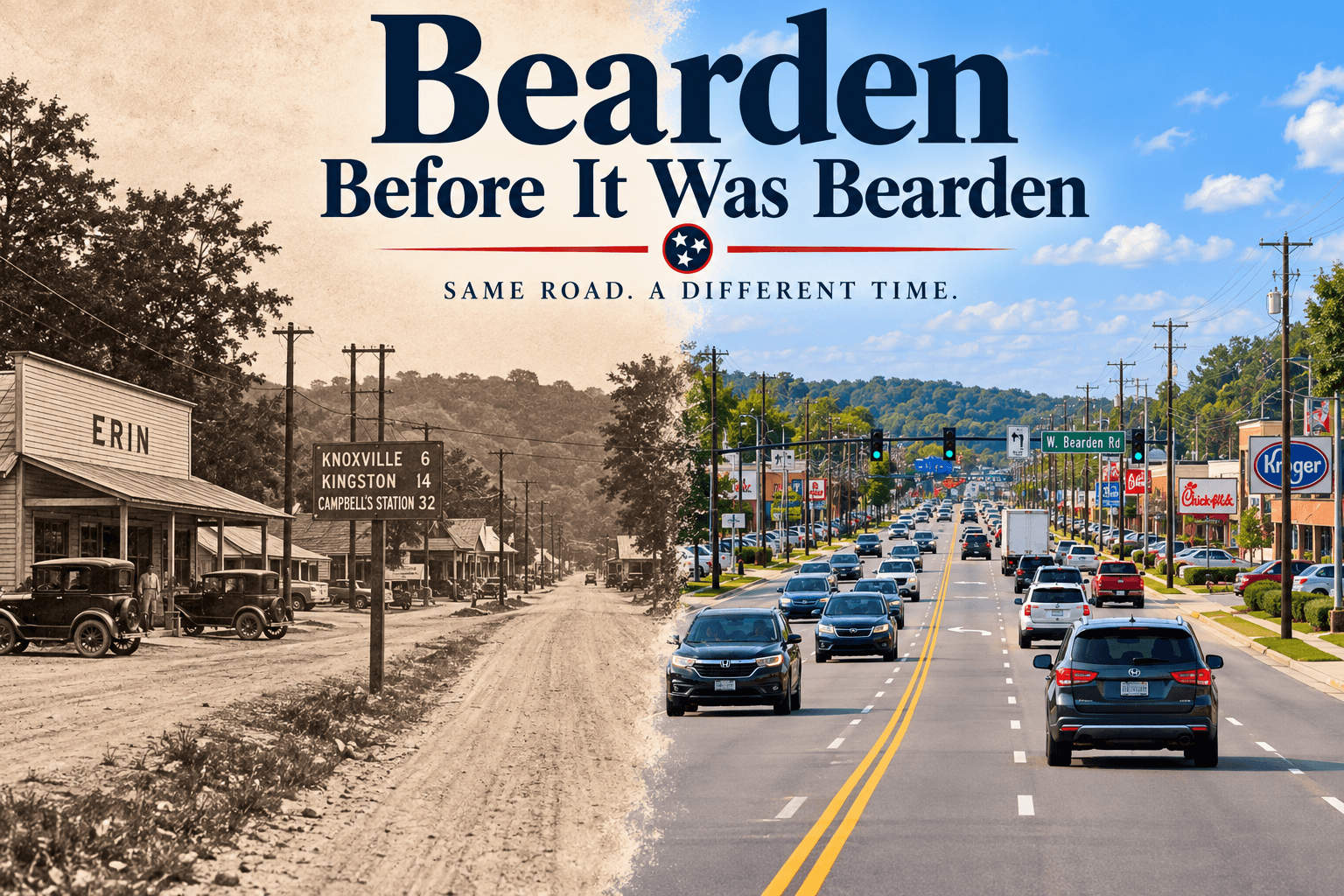
Drive Kingston Pike through Bearden today and it can be difficult to imagine the neighborhood without restaurants, shops, traffic lights and steady streams of cars.
But Bearden's story began when West Knoxville was still countryside and Kingston Pike was a very different road.
In fact, Bearden wasn't even called Bearden.
The early settlement was known as Erin, a name associated with the area's Irish roots. The community developed near Fourth Creek around what is now the Kingston Pike and Northshore Drive area, where an early fortified structure once stood.
And from nearly the beginning, the road running through the settlement helped determine what the community would become.
Before Bearden, There Was Erin
Irish immigrant John Reynolds purchased land in the area in 1817, and the settlement became known as Erin, an old poetic name for Ireland. Reynolds' family would become deeply connected to the area, and the historic Knollwood home on Bearden Hill remains one of the neighborhood's links to that earlier era.
The settlement was small.
There were farms, mills and eventually the familiar elements of a rural village: a post office, school, blacksmith, stores and a railroad station. Fourth Creek supplied water and power, while the road through the community connected residents with Knoxville and communities farther west.
That road had been surveyed in 1792 as a public highway extending west from Knoxville toward Campbell's Station. It became what we now know as Kingston Pike and was Knox County's first improved road.
But early Kingston Pike would hardly be recognizable to today's drivers.
Kingston Pike Didn't Always Follow Kingston Pike
One of the more fascinating pieces of Bearden history is that the old road did not simply climb over Bearden Hill along today's familiar route.
It curved around it.
Parts of the old route followed areas associated today with Deane Hill Drive and Lockett Road before reconnecting with the present corridor. The wooded, twisting stretch offered poor visibility and developed an ominous reputation. It became known as Murderer's Hollow, a place associated with highwaymen preying on travelers.
That seems almost impossible to reconcile with modern Kingston Pike.
Yet transportation would repeatedly reinvent Bearden.
How Erin Became Bearden
The name that survived came from Capt. Marcus De Lafayette Bearden, a Union Army veteran who later served in public office and owned a farm in the community.
There is an interesting wrinkle to the story.
Another Marcus De Lafayette Bearden, the captain's older cousin, had previously operated a paper mill with Gideon Hazen along Third Creek. That mill is connected to the name Papermill Drive. But the community itself was named for the younger Capt. Bearden.
The name Bearden was adopted in 1883, according to Knoxville-Knox County planning history.
The little community now had the name we know today.
But its biggest transformation was still ahead.
When America Started Driving Through Bearden
By the early 20th century, Kingston Pike had become much more than a local road.
It eventually carried two important national travel routes, the Dixie Highway and Lee Highway, funneling travelers through East Tennessee on journeys between northern and eastern states and destinations in Florida and along the Gulf Coast.
Suddenly, Bearden had customers.
Roadside businesses sprang up to serve motorists: filling stations, restaurants, tourist camps, motor courts and other establishments designed for people passing through town.
By 1940, historian Jack Neely notes, just a half-mile stretch of Bearden contained eight tourist camps or motor courts.
Names such as Kozy Kamp, Camp Delight, the Wayside Inn, White Dot Coffee Shop and Canary Cottage once belonged to the Kingston Pike landscape.
Long before interstate exits were surrounded by hotels, gas stations and restaurants, Bearden was already learning how to serve the American automobile traveler.
That roadside economy helped establish something that remains central to Bearden's identity today:
Kingston Pike as a commercial corridor.
From Highway Stop to West Knoxville
Bearden remained outside Knoxville's city limits longer than many people might expect.
For decades, it was distinctly separate from Knoxville, a largely rural community beginning where the city ended. That changed in 1962, when Bearden was annexed into Knoxville.
By then, West Knoxville was changing quickly.
Western Plaza opened in 1957, followed later by West Town Mall and the continuing spread of residential and commercial development westward. Meanwhile, the Interstate Highway System diverted much of the long-distance traffic that had once traveled Kingston Pike.
Bearden stopped being a roadside destination for cross-country travelers.
But it didn't stop being a destination.
The motor courts and tourist camps disappeared. Shops, restaurants, offices and neighborhoods took their place. Kingston Pike remained the spine holding the community together.
Look Beyond the Traffic
That's what makes Bearden particularly interesting today. Much of its history isn't sitting behind museum glass. It's underneath and alongside places thousands of people pass every day.
Fourth Creek still winds through the neighborhood. Knollwood still overlooks Kingston Pike. Old road alignments preserve pieces of a route travelers once followed around Bearden Hill. Names such as Lonas, Lyons, Reynolds and Bearden remain scattered across the modern landscape.
And Kingston Pike is still doing what it has done for more than two centuries:
bringing people through Bearden.
The next time you're stopped at a traffic light somewhere along the Pike, consider what came before the pavement and shopping centers.
Before Bearden was Bearden, there was a little settlement called Erin.
And the road running through it helped turn that settlement into one of Knoxville's most recognizable communities. |
0 Comments
Join the conversation
Be the first to comment
Share your thoughts above.