
The Walker Sisters of Little Greenbrier |
Unveiling the Untold Adventures of the Enigmatic Walker Sisters - Discover the captivating legacy of these trailblazing women. |
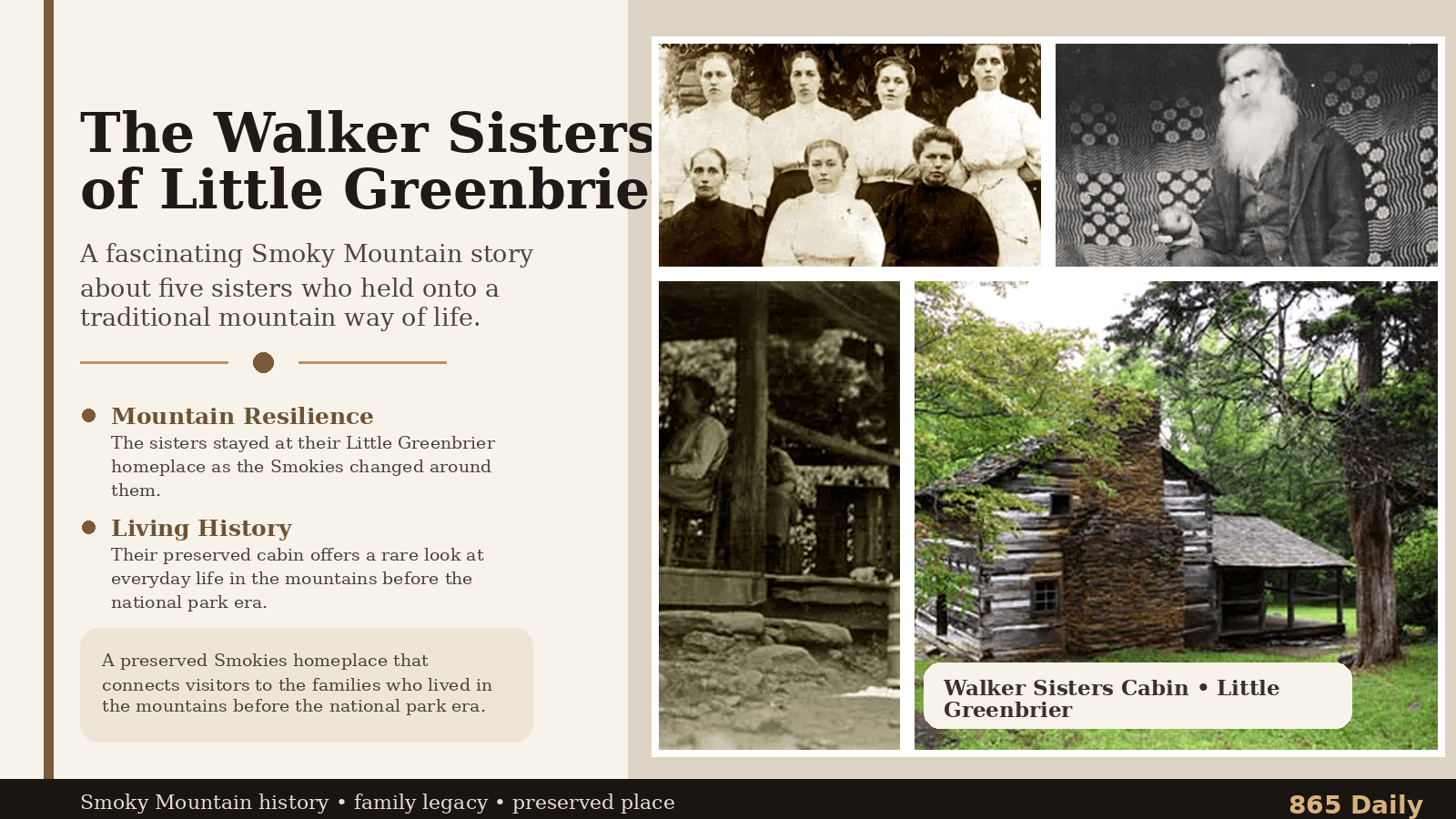
Tucked into the Little Greenbrier area of Great Smoky Mountains National Park is one of the most fascinating human stories in the Smokies: the story of the Walker Sisters.
The sisters — Margaret, Polly, Martha, Louisa, and Hettie Walker — lived for decades on their family homestead in Little Greenbrier, maintaining a self-sufficient mountain lifestyle well into the 20th century. At a time when roads, electricity, tourism, and modern conveniences were reshaping East Tennessee, the Walkers continued to live much as their family had for generations.
Their homeplace is still preserved today, giving hikers a quiet look into a very different Smoky Mountain life.
A Family Rooted in Little GreenbrierThe Walker family’s story began before the national park existed.
John Walker, a Union veteran of the Civil War, and his wife, Margaret Jane King Walker, raised a large family in Little Greenbrier. They had 11 children — seven daughters and four sons. Over time, the sons left home, and one daughter married and moved away. The remaining unmarried daughters stayed on the family farm and eventually inherited it after their father died in 1921.
The farm was not a quaint retreat. It was a working mountain homestead. The sisters gardened, raised animals, preserved food, made clothing, gathered plants, and relied on practical skills passed down through family and community life.
Their way of life required constant work. There was no quick grocery run, no modern household setup, and no easy separation between home, food, labor, and survival. The rhythm of the year mattered: planting, harvest, preserving, firewood, livestock, weather, and maintenance.
That is part of why their story still resonates. The Walker Sisters were not performing “old-time” mountain life. They were living it.
When the National Park ArrivedThe creation of Great Smoky Mountains National Park changed everything for families who lived within what became park boundaries.
Many mountain residents sold their land and moved away as the park took shape. The Walker Sisters resisted leaving their homeplace. Eventually, they sold their land but received a lifetime lease that allowed them to remain there. They continued living at the homeplace for years after the park was dedicated.
That decision made them unusual. As the Smokies became a national park and tourism increased, the sisters became living links to the mountain communities that had existed before the park.
Visitors began seeking them out. The Walker Sisters sold handmade items and became known to people curious about a lifestyle that already felt old-fashioned to many Americans by the mid-20th century. Their fame grew after national attention brought more visitors to their cabin.
But the heart of the story is not novelty. It is continuity.
They stayed because Little Greenbrier was home.
What Remains TodayToday, visitors can hike to the Walker Sisters Place and see preserved pieces of that homeplace.
The National Park Service describes the route from Metcalf Bottoms Picnic Area to the Little Greenbrier School and Walker homesite as a 3.4-mile roundtrip hike. Along the way, visitors can see the historic one-room Little Greenbrier School, stonework, and the preserved Walker family homesite. The cabin includes two spacious rooms with fireplaces and a front porch, and the site also includes a spring house and corn crib.
The Little Greenbrier School is part of the same larger community story. Built in 1881 from tulip poplar logs, it served as a school, church, and gathering place for the mountain community.
The Walker Sisters Cabin has also received preservation attention in recent years. The park closed the cabin in late 2021 for repairs, and the National Park Service announced in 2023 that renovations were complete and the cabin had reopened to the public. Work included roof replacement, foundation stabilization, fireplace restoration, wall timber repairs, and new floorboards.
That preservation matters because the site is more than an old cabin. It is a rare physical connection to families who lived in the Smokies before it became a national park.
Why the Story Still MattersThe Walker Sisters are often described as symbols of old mountain life, but their story is more layered than nostalgia.
They represent independence, tradition, resilience, and attachment to place. They also remind us that the creation of the national park preserved extraordinary landscapes while also reshaping the lives of real communities. The Smokies were not empty wilderness when the park was formed. They were home to families, farms, churches, schools, cemeteries, roads, and memories.
That is what makes the Walker Sisters story so powerful. It connects scenic beauty to human history.
When visitors stand at the cabin today, they are not just seeing where five sisters lived. They are seeing a doorway into a way of life that required skill, discipline, endurance, and deep familiarity with the land.
How to VisitThe Walker Sisters Place can be reached by hiking from Metcalf Bottoms Picnic Area on a route that includes the Little Greenbrier School and the Walker homesite. The National Park Service lists the hike as 3.4 miles roundtrip and notes that pets are not allowed on this trail. A parking tag is required if parking in the Smokies for more than 15 minutes.
Because conditions in the Smokies can change, visitors should check current road and trail conditions before heading out, bring water, wear appropriate shoes, and allow time to explore respectfully.
This is not a loud attraction. It is best experienced slowly.
The Local TakeawayThe Walker Sisters of Little Greenbrier are one of the Smokies’ most meaningful stories because they make the park feel personal.
Their cabin, spring house, corn crib, and nearby schoolhouse remind visitors that the Smokies are not only mountains, trails, waterfalls, and overlooks. They are also homeplaces, family stories, hard work, and choices about what to hold onto when the world changes.
For East Tennesseans, the Walker Sisters story is a reminder that local history does not always live in museums. Sometimes it waits at the end of a forest trail, in a quiet cabin where the past still feels close. |
0 Comments
Join the conversation
Be the first to comment
Share your thoughts above.