Is Knox County Running Out of Room to Grow? |
Is Knox County's Growth Hitting a Roadblock? Uncovering the Challenges of Limited Space and Future Development. |
Knox County’s housing conversation is becoming a land conversation.
A recent Knoxville News Sentinel report highlighted a warning from a local housing expert that Knox County is quickly using up its developable land — a concern that could shape the next wave of debates over growth, affordability, density, roads, schools, utilities, and neighborhood change.
The issue is not whether people want to live here. They clearly do. Knoxville-Knox County Planning’s newly released 2025 Development Activity Report says Knox County saw another record-breaking year for residential permits, with demand for housing continuing to drive development. Building activity increased 4% across the county in 2025, with 5,985 residential and non-residential units permitted. Of those, 5,822 were residential units.
The bigger question is where future housing can go.
Planning officials noted that residential approvals have been climbing since 2020, and 2025 brought a shift away from detached single-family homes toward more multi-unit housing. More than twice as many multi-unit homes were approved as detached units, with 3,519 multi-units permitted — a 17% increase from the previous year.
That shift matters because Knox County is facing two pressures at once: more people need places to live, but large undeveloped parcels are becoming harder to find in the places closest to jobs, schools, services, and existing infrastructure.
The 2025 development report says the largest residential subdivision tracts were outside the urban core, which has become more common as undeveloped parcels inside Knoxville city limits decline. Planning officials also noted that with fewer large tracts available in the city, development is spreading more evenly throughout the county, including Northwest, Southwest, Northeast, and East Knox County.
For residents, that has practical consequences. More growth outside the urban core can mean longer commutes, more pressure on rural and suburban roads, more demand for utilities, and more arguments over rezoning. More density closer in can mean neighborhood concerns about traffic, building height, parking, stormwater, and whether new projects fit the character of existing communities.
Knox County has already tried to plan for this tension. The county’s comprehensive land use and transportation planning process was designed to guide development and infrastructure decisions over the next 20 years, analyzing population growth projections, land availability, infrastructure conditions, preservation areas, and places appropriate for new growth and investment.
That planning work is now moving from abstract to immediate. When land is abundant, growth debates can feel theoretical. When buildable land gets scarcer, every rezoning request, subdivision proposal, apartment project, and road improvement becomes part of a larger question: what kind of county does Knox County want to become?
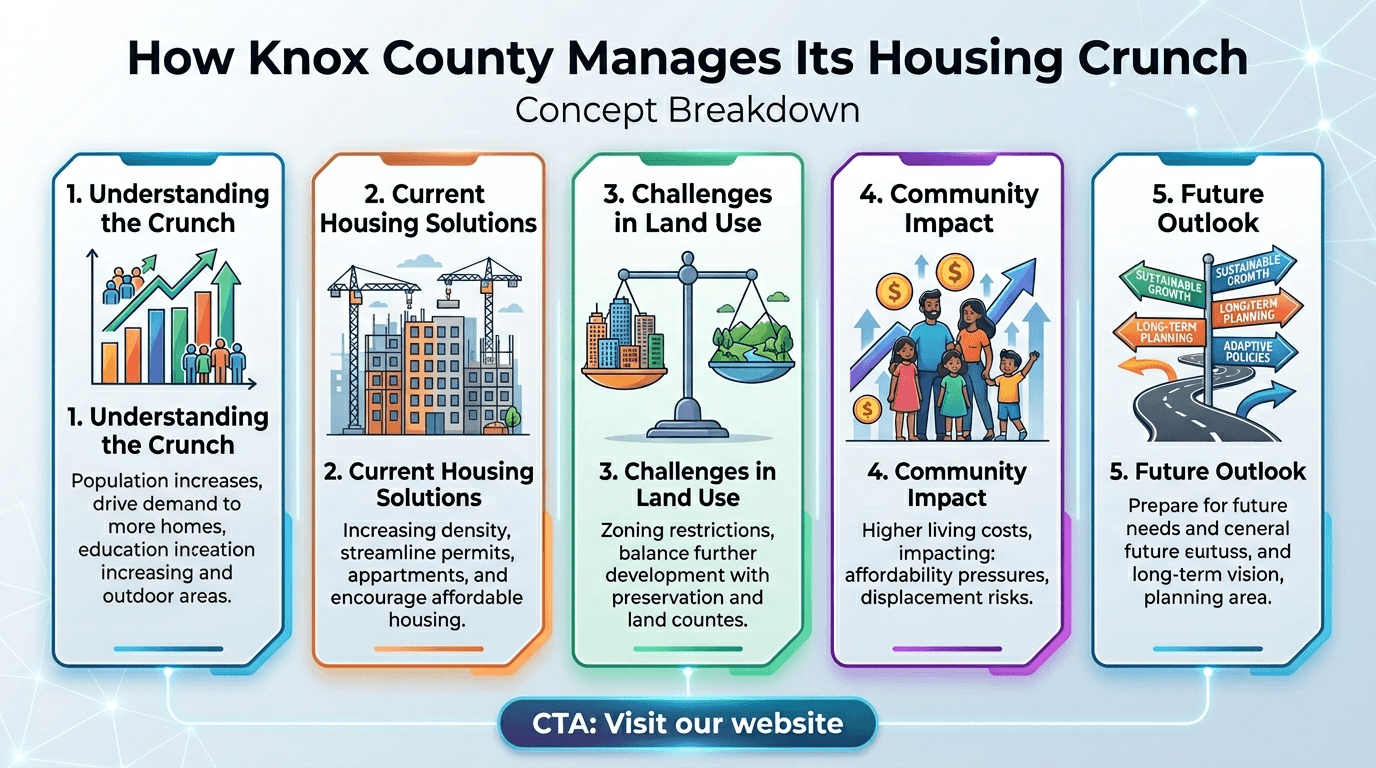
The local takeaway is simple: Knox County’s housing crunch is not just about prices. It is also about land.
If the county wants more homes without pricing out families, young professionals, seniors, and workers, it will likely need a mix of solutions: thoughtful infill, more housing types, better transportation planning, infrastructure investment, and clearer rules about where growth should happen.
For now, the warning is worth paying attention to. Knox County is still growing — but the easy land may not last forever. |
0 Comments
Join the conversation
Be the first to comment
Share your thoughts above.